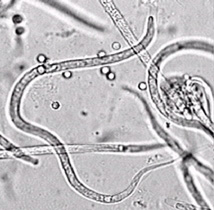
Filiariasis
(Wuchereria bancrofti)
 Wuchereria bancrofti is a nematode that uses mosquitos as an insect vector to infect humans with filiariasis. The mosquito ingests microfilariae when biting a human who is infected with filiariasis. Microfilariae pass through the mosquito gut into the hemocoel and develop into filariform juveniles. Filariform juveniles then escape from mosquito’s proboscis when the insect feeds on the subject. They penetrate the wound and enter the human blood stream and become adult worms. Adult worms develop into sexual maturity in afferent lymphatic vessels of the subject. The worm require six to ten months to become sexually mature. Adult worms then mate, and females produce thousands of microfilariae. The microfilariae can be released for 5 to 10 years in the absence of reinfection. The microfilariae magnate to bloodstream to repeat the life cycle.
The body of an a dult worm include long and slender with smooth cuticle and bluntly rounded ends. The head is slightly swollen and bears two circles of well -defined papillae. The mouth is small, lacking a buccal capsule. Males are about 40mm long and 100mm wide, and females are 6 to 10cm long and 300mm wide. The vulva of this parasite is near the level of its middle of the esophagus.Adult Wuchereria live in the major lymphatic ducts of humans. They tightly coil into nodular masses. The majority of Wuchereria are found in the lymph glands of the lower half of the body.
The incubation period can range from months to years during which no symptoms would occur. When the symptomatic stage begins, however, painful swelling of the extremities occurs along with weakness of the arms and legs, headache, and insomnia. There is a period of recovery which is permanent if reinfection does not occur. If reinfection occurs, however, the cycle repeats, and elephantiasis, a grossly disfiguring disease, may result. Since the parasites reside mostly in the lower half of the body, genital or pedial elephantiasis often require the patient to amputate.